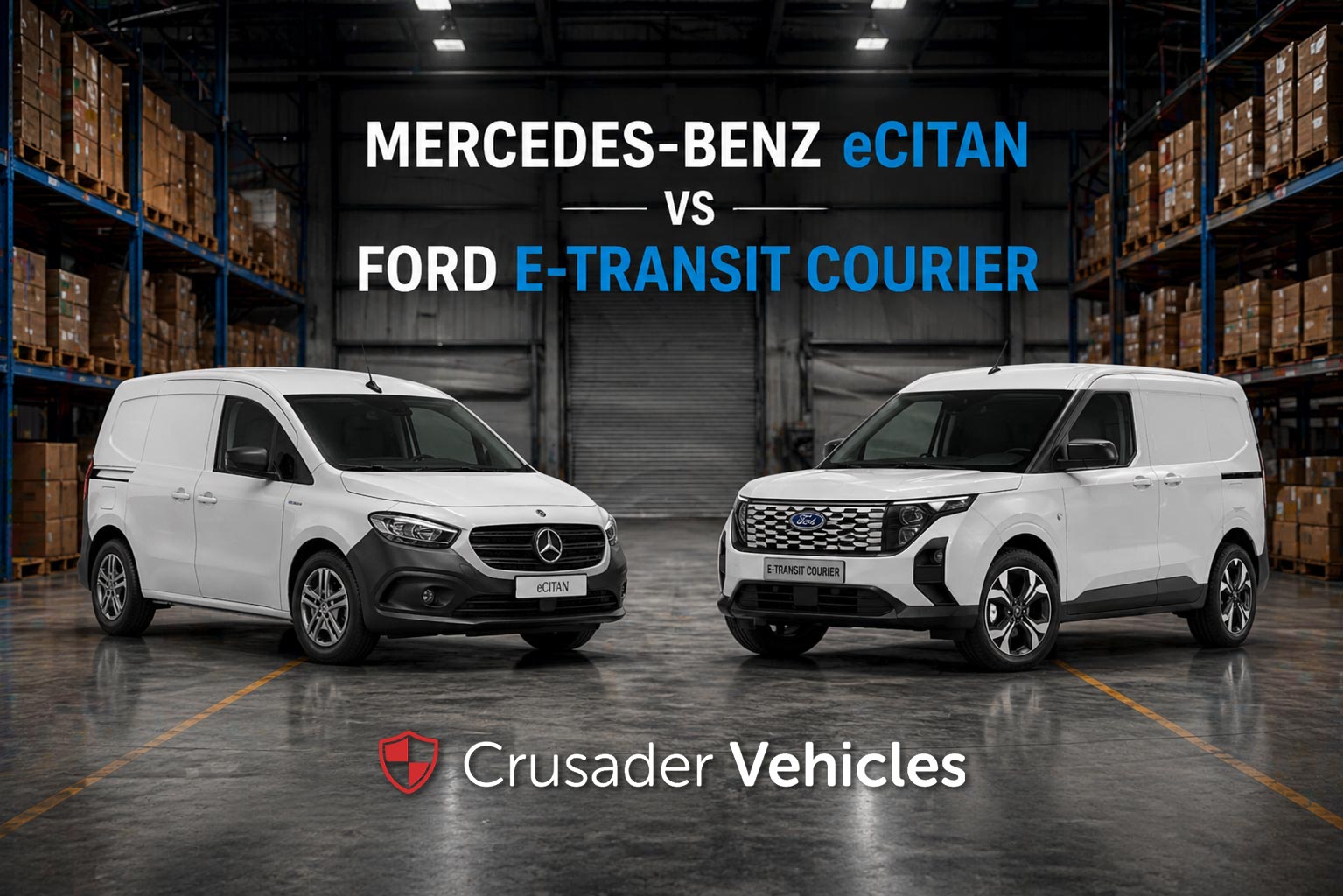
If you're shopping for a small electric van in 2026, these are two of the most compelling options on the market - but they serve quite different customers. The Mercedes eCitan brings premium refinement, flexible load configurations, and a generous aftersales package. The Ford E-Transit Courier offers superior value, faster charging, stronger payload in a single compact package, and the confidence of a Platinum Euro NCAP safety rating.
Both are city-focused electric vans built to eliminate emissions in urban zones, deliver low running costs, and handle the daily demands of small businesses, tradespeople, and fleet operators. But which one actually fits your business better? This guide breaks down every angle that matters.
The Big Picture: Two Very Different Approaches
On paper, these vans sit in the same segment - small electric panel vans with sub-200-mile range. In reality, they're quite different products.
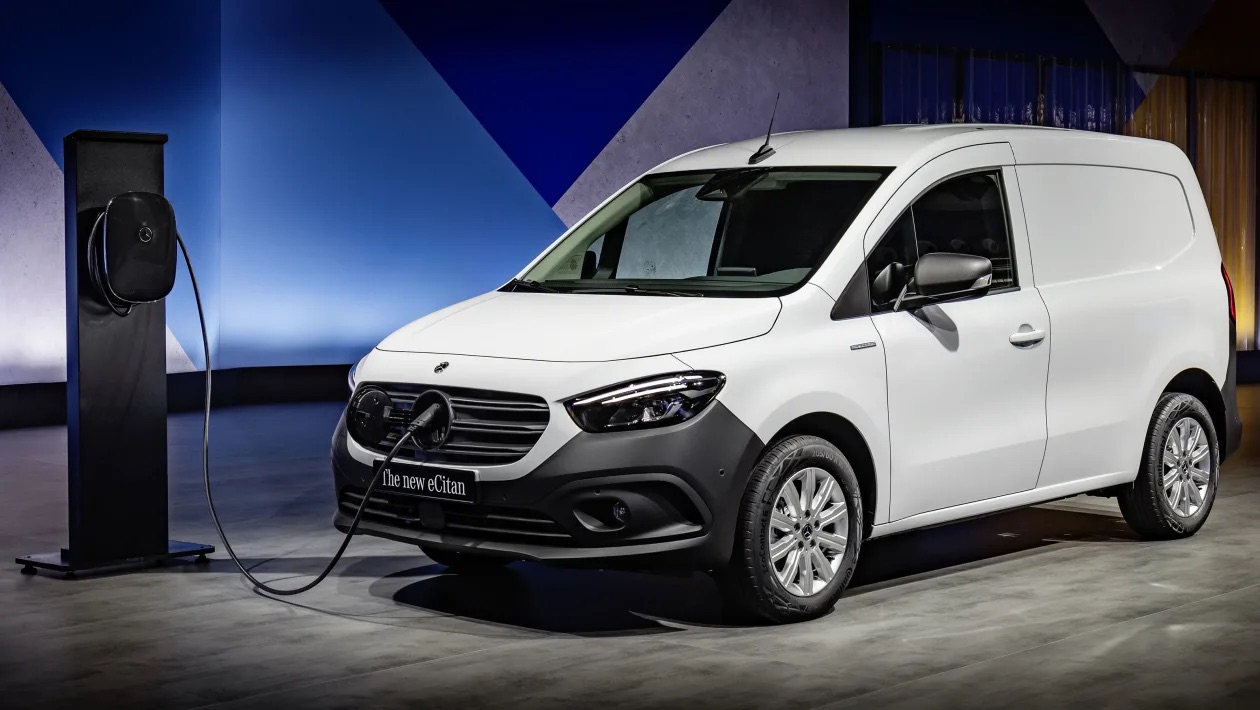
The Mercedes eCitan is a rebadged Renault Kangoo E-Tech with premium Mercedes touches - the MBUX infotainment system, a more upscale cabin, and Mercedes' comprehensive aftersales support. It comes in two body lengths (L1 at 4.5m and L2 at 4.9m), giving you flexibility in load space, and it's the only one of the two that offers a crew cab configuration for carrying both people and cargo.
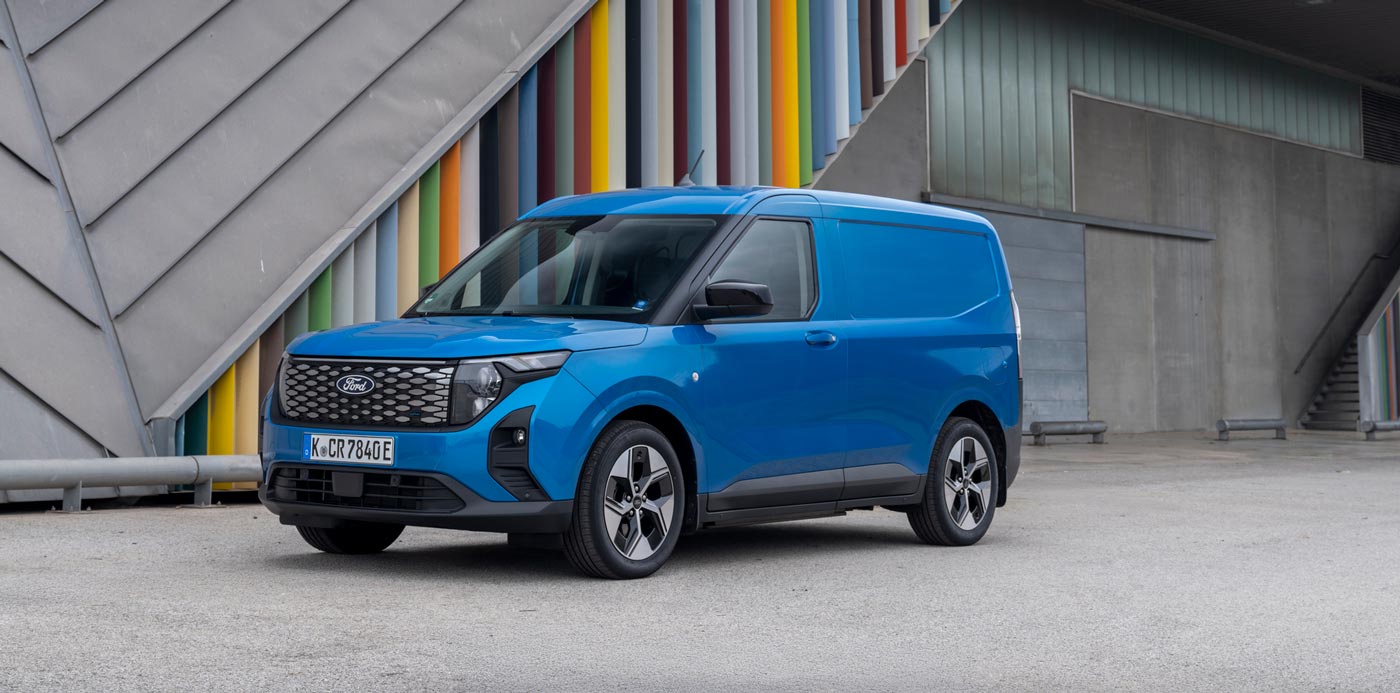
The Ford E-Transit Courier is built on the Ford Puma's car platform, giving it exceptional handling and refinement for a van. It's only available in one length (4.4m), but it compensates with a higher payload ceiling, faster charging, slightly longer range, and crucially - a lower starting price. Ford designed it specifically as an urban delivery workhorse, and that focus shows.
The practical upshot: if you need load space flexibility, towing capability, or want the Mercedes badge and service package, the eCitan is the clear choice. If you prioritise payload, value, and charging speed in a compact city van, the E-Transit Courier wins.
Electric Range & Charging: Ford Edges Ahead
Both vans are built for city and suburban work, not motorway cruising. Let's see how they compare on the metrics that matter.
Range
The Ford E-Transit Courier quotes up to 186 miles WLTP from its 43 kWh battery. The Mercedes eCitan quotes up to 176 miles from a slightly larger 45 kWh pack. In real-world use - factoring in cold weather, urban stop-start driving, and a partial load - both deliver around 135–150 miles between charges. The Ford's slightly more efficient powertrain and aerodynamics give it a marginal edge.
Charging Speed
This is where the Ford pulls decisively ahead. The E-Transit Courier supports DC rapid charging at up to 100 kW, meaning a 10–80% charge takes just 23 minutes. The eCitan maxes out at 75 kW DC, taking 38 minutes for the same 10–80% charge. If you're running multiple deliveries per day and relying on rapid top-ups between routes, those 15 minutes add up quickly.
For overnight charging, the eCitan has an advantage: it supports AC charging up to 22 kW (three-phase), while the Ford maxes out at 11 kW. If you have access to a 22 kW charger at your depot, the Mercedes will fully charge in around 2.5 hours versus 6.5 hours for the Ford. Most businesses charge overnight at 7 kW, though, where both take around six to seven hours.
Verdict: Ford wins on rapid charging speed. Mercedes wins on AC charging flexibility - but only if you have 22 kW infrastructure.
Payload & Load Space: It Depends on What You're Carrying
Payload Capacity
The Ford E-Transit Courier offers a maximum payload of 700 kg - impressive for a small electric van and actually higher than its diesel equivalent. The Mercedes eCitan's payload varies by body length: the L1 manages 544 kg, while the longer L2 handles 722 kg. If you're running a single-size fleet and need consistent 700 kg capacity, the Ford is simpler. If you occasionally need to carry over 700 kg and can spec the L2 eCitan, Mercedes wins.
Load Volume
Here the eCitan has a clear advantage thanks to its two body lengths. The L1 offers 3.3 m³ of cargo space, while the L2 extends that to 4.2 m³ - enough for two Euro pallets in either configuration. The E-Transit Courier offers 2.9 m³ in its single body length, which is competitive but noticeably smaller. If your business regularly carries bulkier loads - furniture, large parcels, building supplies - the eCitan L2 is the better tool.
Towing Capacity
The eCitan can tow up to 1,450 kg braked, making it one of the strongest small electric vans in this regard. The E-Transit Courier is rated for just 750 kg. If towing a trailer is part of your operation - even occasionally - the Mercedes is the only viable option here.
Verdict: Ford offers the best single-size payload. Mercedes offers more load volume and significantly better towing.
Driving Experience: Both Excellent, Ford Slightly Sharper
Both vans benefit from car-derived platforms, which means they handle and ride far better than traditional body-on-frame commercial vehicles.
The E-Transit Courier is based on the Ford Puma SUV platform, and it shows. The steering is direct, body roll is minimal, and the ride quality is genuinely car-like. It won the Parkers Small Van of the Year award in both 2025 and 2026 partly on the strength of its driving dynamics. The 134 PS motor delivers punchy acceleration from rest thanks to 290 Nm of instant torque, and it cruises comfortably at motorway speeds - though wind noise becomes noticeable above 60 mph.
The Mercedes eCitan shares its underpinnings with the Renault Kangoo E-Tech, but Mercedes has tuned the suspension and steering to feel more planted and refined. It's quieter than the Ford at higher speeds, offers slightly softer ride quality over rough surfaces, and the MBUX system's three levels of regenerative braking (D-, D, D+) give more control over energy recovery. The 122 PS motor is adequate rather than rapid, but it never feels underpowered in normal use.
Verdict: Both are excellent to drive. Ford feels sharper and more engaging. Mercedes feels more refined and quieter.
Cabin Quality & Technology: Mercedes Wins on Premium Feel
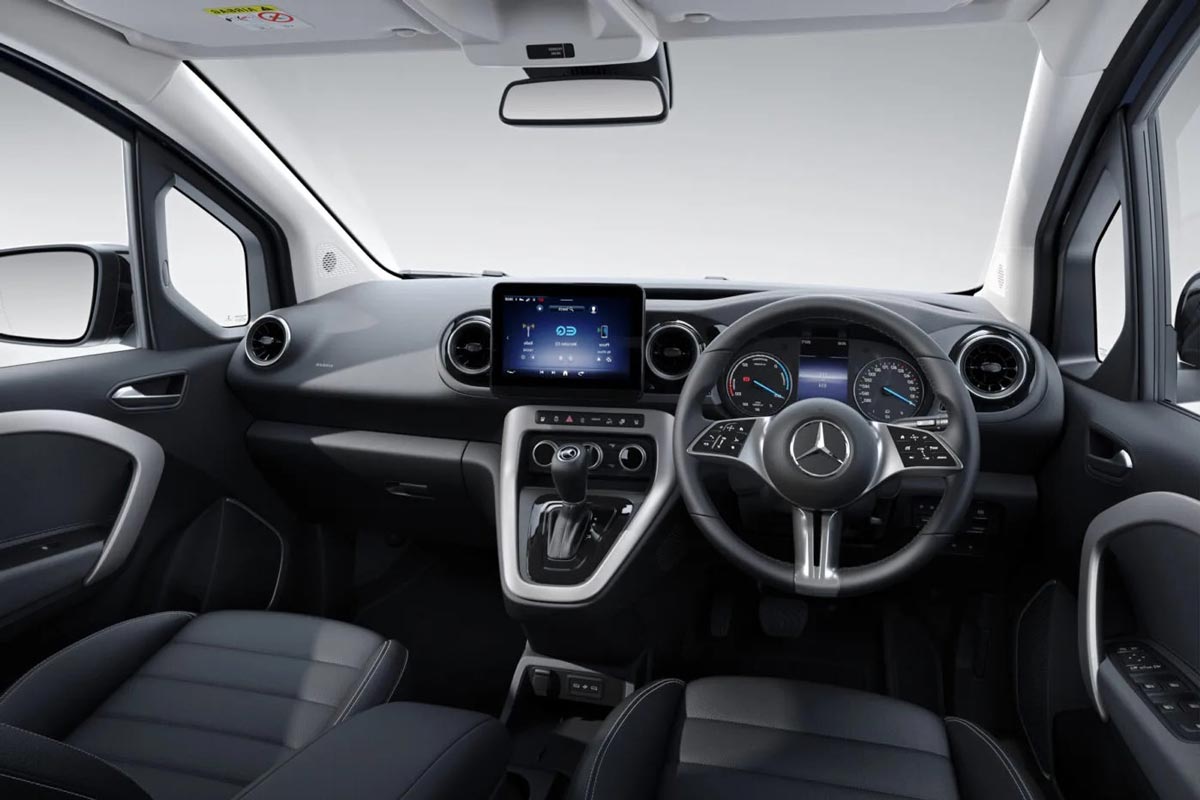
Step into the eCitan and you immediately recognise Mercedes' influence. The MBUX infotainment system - borrowed from Mercedes passenger cars - is one of the best in the commercial vehicle world. The 7-inch touchscreen is responsive, navigation is intuitive, and the 'Hey Mercedes' voice assistant actually works reliably. The cabin materials are a step above most small vans, with soft-touch surfaces, piano-black trim accents, and a chunky three-spoke steering wheel that feels distinctly premium.
The E-Transit Courier's interior is functional and well-designed, but more conventional. Ford's SYNC 4 infotainment system is clear and easy to use, with wireless Apple CarPlay and Android Auto as standard. The driving position is commanding, visibility is excellent, and there's plenty of practical storage around the cab. It doesn't feel cheap - but it doesn't feel as special as the Mercedes, either.
Both vans offer generous front storage, including overhead shelves, door pockets for large bottles, and USB charging points. The eCitan's fixed bulkhead can limit seat adjustment for taller drivers, while the Ford's cabin feels slightly more spacious overall.
Verdict: Mercedes offers a noticeably more premium cabin experience. Ford is practical and well-executed, but less refined.
Safety: Ford Earns Euro NCAP Platinum, Mercedes Gets 5-Star
Both vans are among the safest small commercial vehicles available, but the Ford holds a unique distinction.
The E-Transit Courier became the first van to receive Euro NCAP's Platinum commercial vehicle safety rating under the updated 2024 testing standards. It comes standard with automatic emergency braking with pedestrian detection, lane-keep assist, driver attention alert, adaptive cruise control, and a comprehensive suite of parking aids. The high-strength steel safety cage and six airbags offer excellent occupant protection.
The eCitan earned a 5-star Euro NCAP rating under the 2025 commercial vehicle assessment - itself a strong result. Standard equipment includes Active Brake Assist, Active Lane Keeping Assist, Traffic Sign Assist, and Attention Assist. Mercedes also offers Blind Spot Assist and a reversing camera as standard on Premium trim.
Verdict: Both are exceptionally safe. Ford's Platinum rating is the highest accolade in the segment.
Price & Value: Ford Offers Significantly Better Entry Point
Van leasing deals don’t stand still - and that’s something worth keeping in mind.
One month, the Ford might be the standout deal. The next, the Mercedes could come through stronger. Manufacturer support, stock levels and finance rates all shift regularly, so the “best value” option can change quicker than you’d expect.
Right now, the Ford E-Transit Courier generally comes in at a lower starting point - around £27,000 ex-VAT (after the Plug-in Van Grant) - compared to the Mercedes eCitan L1 Progressive at around £32,700 ex-VAT. That’s a noticeable gap, especially for small businesses or sole traders watching costs closely.
But price isn’t everything.
With the eCitan, you’re paying for a more premium feel - including the MBUX system, a four-year service and maintenance package, and more flexibility with body styles and crew cab options. For some, that added spec makes sense. For others, the Ford does exactly what’s needed at a lower monthly cost.
The key thing?
Don’t assume one van is always the better deal.
The smartest move is to keep an eye on current offers - because the best-value van this month might not be the same next month.
View current Mercedes eCitan lease deals at Crusader Vans →
View current Ford E-Transit Courier lease deals at Crusader Vans →
Aftersales & Warranty: Mercedes Offers More Comprehensive Package
Both vans come with a three-year manufacturer warranty. After that, the packages diverge.
Mercedes includes a four-year inclusive service and maintenance plan with every eCitan - covering routine servicing, breakdown assistance, and out-of-charge recovery at no additional cost. The battery is covered by an eight-year or 100,000-mile Battery Capacity Warranty, guaranteeing at least 70% capacity retention. This level of included support is rare in the commercial vehicle world and represents genuine value for fleet operators planning to lease beyond the standard three-year term.
Ford offers a three-year, 60,000-mile warranty as standard, with optional extended warranty packages available at extra cost. Service plans are available but not included. The E-Transit Courier benefits from Ford's vast UK dealer network, which means parts availability and service accessibility are generally excellent - often better than Mercedes in rural areas.
Verdict: Mercedes offers the more comprehensive aftersales package as standard. Ford has the wider service network.
Full Specification Comparison
All specs are for 2025/26 model year electric variants. Leasing prices change regularly - click the links above to check current Crusader Vans deals.
|
|
Mercedes-Benz eCitan |
Ford E-Transit Courier |
|
Platform |
Renault Kangoo E-Tech based |
Ford Puma SUV based |
|
Body lengths |
L1 (4.5m) & L2 (4.9m) |
Single length (4.4m) |
|
Battery capacity |
45 kWh (usable) |
43 kWh (usable) |
|
WLTP range |
Up to 176 miles |
Up to 186 miles |
|
Real-world range |
~135–140 miles |
~140–150 miles |
|
DC rapid charging |
75 kW (10–80% in 38 mins) |
100 kW (10–80% in 23 mins) |
|
AC charging |
Up to 22 kW |
Up to 11 kW |
|
Motor power |
122 PS (90 kW) |
134 PS (100 kW) |
|
Torque |
245 Nm |
290 Nm |
|
Max payload – L1/standard |
544 kg |
700 kg |
|
Max payload – L2/long |
722 kg |
700 kg (single size) |
|
Load volume – L1/standard |
3.3 m³ |
2.9 m³ |
|
Load volume – L2/long |
4.2 m³ |
2.9 m³ |
|
Towing capacity (braked) |
Up to 1,450 kg |
750 kg |
|
Cab configurations |
Panel van, Crew cab |
Panel van only |
|
Trim levels |
Progressive, Premium |
Base, Trend, Sport |
|
Infotainment |
MBUX 7" touchscreen |
SYNC 4 touchscreen |
|
Driver assistance |
Full ADAS suite |
Euro NCAP Platinum |
|
Euro NCAP rating |
5-star (2025) |
Platinum (2024) |
|
Warranty (standard) |
3 yr + 8 yr battery |
3 yr / 60k mi |
|
Aftersales package |
4-yr service plan included |
Service plans available |
|
Starting lease price |
Verdict: Which Should You Choose?
Choose the Mercedes-Benz eCitan if you…
- Need the flexibility of two body lengths (L1 and L2) for varying load requirements
- Want a crew cab option for carrying both crew and cargo
- Need to tow a trailer regularly (up to 1,450 kg braked capacity)
- Value the premium MBUX cabin experience and Mercedes badge
- Want the four-year inclusive service and maintenance package
- Have access to 22 kW AC charging infrastructure at your depot
Choose the Ford E-Transit Courier if you…
- Want the best value small electric van with a lower starting price
- Prioritise fast DC charging (100 kW, 10–80% in 23 minutes)
- Need consistent 700 kg payload across a single-size fleet
- Value driving dynamics and car-like handling above cabin luxury
- Want the confidence of a Euro NCAP Platinum safety rating
- Operate primarily in urban areas with access to rapid chargers
Both are outstanding small electric vans that will serve a business well for years. The most important thing is the deal on the table right now — check both our eCitan and E-Transit Courier pages for the latest leasing offers and let our team find you the best value.
Frequently Asked Questions
Which is cheaper to lease — the Mercedes eCitan or the Ford E-Transit Courier?
The Ford E-Transit Courier has a significantly lower starting price (from ~£27,000 ex-VAT after PiVG) compared to the Mercedes eCitan L1 (from ~£32,700 ex-VAT after PiVG). Monthly lease rates reflect this gap, though deals change regularly. We recommend checking our live eCitan deals and E-Transit Courier deals for the most accurate current pricing.
What is the real-world range of the eCitan and E-Transit Courier?
The Ford E-Transit Courier quotes up to 186 miles WLTP; the Mercedes eCitan quotes up to 176 miles. In real-world conditions — including cold weather, urban stop-start driving, and a partial load — both deliver around 135–150 miles per charge. The Ford's slightly more efficient powertrain gives it a marginal edge in typical use.
Can I tow a trailer with the Ford E-Transit Courier?
Yes, but the E-Transit Courier is rated for just 750 kg braked towing capacity. The Mercedes eCitan can tow up to 1,450 kg braked, making it far more capable for businesses that regularly tow trailers or equipment.
Which van has better payload capacity?
The Ford E-Transit Courier offers a maximum payload of 700 kg in its single body length. The Mercedes eCitan L1 manages 544 kg, while the longer L2 handles 722 kg. If you need consistent 700 kg capacity across a fleet, the Ford is the simpler choice. If you occasionally need over 700 kg and can specify the L2, Mercedes wins.
How long does it take to charge each van?
Using a 7 kW home wallbox, both vans take around 6–7 hours to fully charge overnight. For rapid charging, the Ford E-Transit Courier supports up to 100 kW DC (10–80% in 23 minutes), while the Mercedes eCitan maxes out at 75 kW DC (10–80% in 38 minutes). If you rely on rapid top-ups during the working day, the Ford's faster charging is a meaningful advantage.
Which van is better for city deliveries?
Both are excellent urban vans. The Ford E-Transit Courier is slightly more compact (4.4m vs 4.5m/4.9m), handles more sharply, and charges faster — making it ideal for high-frequency urban delivery routes. The Mercedes eCitan offers more load volume flexibility with its two body lengths, making it better if you carry a wide variety of cargo sizes.
Is the Mercedes eCitan just a rebadged Renault Kangoo?
Mechanically, yes — the eCitan shares its platform, battery, and motor with the Renault Kangoo E-Tech. However, Mercedes has added its own suspension tuning, steering calibration, the MBUX infotainment system, a more premium cabin, and a comprehensive four-year service package. The driving experience and ownership proposition are noticeably different from the Renault.
What aftersales support comes with each van?
The Mercedes eCitan includes a four-year inclusive service and maintenance plan covering routine servicing, breakdown assistance, and out-of-charge recovery. The battery is covered for eight years or 100,000 miles. The Ford E-Transit Courier comes with a three-year, 60,000-mile warranty, with optional service plans available at extra cost. Ford's wider UK dealer network often makes servicing more accessible in rural areas.
Which van has the best safety rating?
The Ford E-Transit Courier earned the first-ever Euro NCAP Platinum commercial vehicle safety rating under the 2024 standards — the highest accolade in the segment. The Mercedes eCitan earned a 5-star Euro NCAP rating under the 2025 assessment, which is also excellent. Both are among the safest small vans available.
What are the best alternatives to the eCitan and E-Transit Courier?
The main alternatives are the Stellantis family of small electric vans - the Citroën ë-Berlingo, Peugeot e-Partner, Vauxhall Combo Electric, and Fiat E-Doblò. These share the same 50 kWh battery and 136 PS motor, offering slightly longer range (around 205 miles WLTP) and more payload than the eCitan or E-Transit Courier. The Renault Kangoo E-Tech and Nissan Townstar EV are mechanically identical to the eCitan but typically cost less. Crusader Vans can provide quotes on all of these models.
About Crusader Vans
Crusader Vans, established in 2004, stands with the strength of reliability and customer satisfaction in the van leasing sector, having fulfilled the diverse requirements of over 8,000 clients nationwide. Our offering pivots around providing a seamless, comprehensive leasing experience with a wide array of brand-new vehicles supplied directly by UK main dealers to choose from.
Clients enjoy free mainland UK delivery, transparent fixed monthly costs, and the latest vehicle technology with every new lease agreement, all wrapped in a package meticulously tailored to individual budget and need. Embrace the opportunity to navigate the roads in the latest models with unwavering support and expert advice, ensuring your journey with Crusader Vans is consistently smooth, enjoyable, and distinctly yours.

Contact Us
Feel free to get in touch with a member of our team for more information or to chat about your van needs.
Address: Crusader House, High Street, Buxted, East Sussex, TN22 4LA
Phone: 01825 701200
Email: enquiries@crusadervans.co.uk
Website: www.crusader-vans.co.uk